milliondollarmix

By Ray Gonzales, Ph.D.

How do you spend $1 billion dollars?  That’s the question The California Endowment (TCE), the state’s largest health foundation, had to answer.  In 2010, TCE committed $1 billion dollars in a ten-year period, 2010-2020, in a strategic investment in Building Healthy Communities (BHC) in 14 of the state’s highest needs communities.  These communities started from Del Norte County near the Oregon border to City Heights near the Mexican border, and included such well-known poverty areas as East Salinas, East Oakland, Southeast Santa Ana, as well as South Kern, made up of Arvin, Lamont, Weedpatch and Greenfield areas.

The 14 BHC sites were selected by the California Endowment using a number of critical indicators—health outcomes such as Type 2 diabetes, among others; poverty rates and employment statistics, and; education attainment of both adults and children of the area.  TCE also considered geographic diversity—rural and urban, and ethnic diversity.  Another, and important, consideration was any previous grant-making experience of the region, and the capacity of potential grantees to move policy and systems’ agenda.  The political will and capacity to organize and develop grassroots leadership was also a significant factor in site selection.

Setting the stage, the state and the entire nation had been hit with the Great Recession of 2008.  The California budget was in the tank, and Obama’s Washington was in the grip of political gridlock of historic proportions.  By 2010 the state, while still in critical condition, was coming out of intensive care.  The California Endowment, again seeing a tremendous need to improve community health, sought to initiate a new and daring program. TCE would improve health delivery systems by moving policies, practices, and power dynamics, to improve the environment, education, and social and economic outcomes.  The rationale was that these social determinants of health—like income, education, and neighborhood conditions are often at the root of poor health and health disparities.

The plan was based on the premise that health is much more than just health care, and that whatever success the project had in the 14 communities, the findings and practices would not end in those communities, but be spread throughout the state, and even the nation.  And finally, BHC should demonstrate that Just Health is about more than just policy changes—it is about long-lasting civic capacity.

At the midway point of Building Healthy Communities and with an expenditure of nearly half a billion dollars, dramatic changes are seen in targeted communities where numerous citizen organizations and thousands of individuals have had a serious and constructive impact on the education, environment, safety levels, and economic conditions that have all aided in improving the health of the community.

South Kern residents gearing up for this year's  "Live the Challenge." More than 300 residents showed up to run their choice of a 5K or 10K run.
South Kern residents gearing up for this year’s “Live the Challenge.” More than 300 residents showed up to run their choice of a 5K or 10K run.

In South Kern, groups pressured the Board of Supervisors to revoke a permit and fine a recycling center, which was a chronic polluter.  In Del Norte, Native American groups pressured to have healthy lunches provided for needy school children.  In South Los Angeles school officials were forced to change how truancy tickets were used in the school district.  And in Richmond, a coalition of Black and Latino organizations opposed the Sheriff’s plan to expand the prison system, and got the Police Chief to oppose the Sheriff and support their proposal for a re-entry program instead.

Many of the conditions in the 14 communities, which are as distinct as rural South Kern or East Oakland, have much in common.  With the exception of Del Norte (Native American), Latinos make up the single largest ethnic group at all sites.  In Coachella, Boyle Heights and South Santa Ana they are 90 percent.  In South Kern they are 79 percent.  African Americans make up the largest group (39 percent) in East Oakland and Richmond.

Thirteen sites have large immigrant populations with 54 percent in Central Santa Ana.  South Kern has a 61 percent immigrant population, made up of Mexicans, Salvadorans, Guatemalans and East Indians.  This is a key figure, not only in these locations, but in all of the sites. The Endowment believes that the Building Healthy Communities sites reflect “the next California,” as in all the 14 sites, ethnic groups are the majority of the population.

Youth Development

The California Endowment has targeted programs specifically for youth.  The statistics are ominous: low graduation rates, diminishing economic and academic opportunities, higher rates of diet-related diseases, and a higher incidence of violence are all too common for youth in the BHC sites.  Some of the locations among the 14 sites are serious danger zones for youth of the communities.  Recent studies in the National Journal indicate that Kern County has the lowest high school graduation rate of Latinos in the country, at only 50 percent.  Likewise, it is the lowest in the nation for Latinos with bachelors’ degrees at 5 percent.  The educational needs among the residents of South Kern are even more serious than the county averages that lead the nation.  What does this say about opportunities for good employment, home ownership, safe neighborhoods for children, and good health in general?

Yet, while the statistics and the past conditions are daunting, it is the youth at many of the BHC sites that are leading the efforts for improvement.  They understand that it begins with a good education.  Schools serve as hubs for comprehensive change in these rural communities.  In South Kern (Arvin, Lamont, Weedpatch, and Greenfield) for example, family resource centers are based at the schools.  These are locations familiar and trusted by the residents.  This is where they go to access many of the other services provided by BHC.  The overriding success of BHC projects is a result of this school to home to individual set up.

Jennifer Wood-Slayton, the hub manager for south Kern, has her offices located at the Lamont School District site.  “People feel comfortable coming here.  They can access health support, nutrition benefits, and the young people join to get involved in safe parks work, clean air and water monitoring, and much more.”

Much of the work of the BHC youth groups has been dramatic and historic.  In Boyle Heights and South Los Angeles, youth are leading and winning the effort to reform school discipline policies.  The higher incidence of school suspension of Latino and Black students was challenged by youth organizations.  They were successful in getting the school district to change the policy.  The Governor of the State has also signed several bills addressing the punitive school discipline issue.  In South Kern, youth and community groups are participating in a current lawsuit filed against the Kern High School District for its over-zealous suspension of minority students.  This is just another instance where one local issue has spread across the state addressing similar problems.

As one TCE program manager put it, “This wasn’t about an outside organization saying ‘hey system leaders, this is what you should be doing.’  It was the voices of the youth themselves saying this is what I am experiencing, this is what I need.”  Students are talking to one another, going to the power brokers—principals, local politicians, school board members, to make their points.  They seek to clean up public parks, improve community lighting, provide recreation and learning centers, improve diets for poverty students.  South Kern, because it is a rural area that leads the nation in so many negative ways—polluted air, low education levels, lack of health insurance, unemployment and low wage employment, poor health conditions…has a tremendous job ahead of it.  But The California Endowment, is aware of this and that is why it was selected as a site for Building Healthy Communities.  The work is well underway.

BHC South Kern All Action Team Meeting.

The Goals of Building Healthy Communities

The California Endowment has undertaken a major program—an expansive and inclusive vision for healthy communities in all of California.  But getting there with a program that benefits everyone requires starting in the communities with the greatest health disparities.  These communities represent the future of California because they are younger than the general population of the region and the state.

Annalisa Robles, a Bakersfield Native and now a Program Manager for the Endowment, travels the state, facilitating partnerships, developing strategy and offering support.  She spends a great deal of time in South Kern and is very optimistic.  “For far too long, residents of South Kern have experienced generations of poverty, trauma and discrimination.  When communities feel marginalized they feel powerless.  Through Building Healthy Communities—South Kern, residents and particularly youth are finding their voice to take collective action, hold decision-makers accountable and partner to bring transformative change for all.”

As noted in the beginning, TCE believes that the path to better health goes through a process where improving the education, the social structure, and the economy of these communities is necessary to reach a goal of healthier communities.  Clearly, the dollar investment of TCE has already brought thousands of people into the process of participating, as leaders and recipients of the changing and improving conditions.  While the project is at mid-way point, it is clear that BHC is off to a tremendously successful beginning.  (On other occasions, I will focus on the activities in the targeted communities of Arvin, Lamont, Weedpatch and Greenfield.)

Sources:  USC Program for Environmental and Regional Equity, 2014.  The National Journal. June, 2015.  Kern County Statistical Abstract, 2014.  Personal Interviews with project leaders and site visits.

Ray Gonzales, Ph.D., is a retired California State University Professor who also served in the State Legislature; U.S. Diplomatic Service; Director of Recruitment for U.S. Peace Corps, and currently serves on the Bakersfield City School District Board. Over 250 published articles and latest book: A Lifetime of Dissent, 2006.

quilt-one

Building Healthy Communities- South Kern (BHC-SK) has opened its grant program, which awards up to $500 for projects that aim to improve community health in South Kern.

The fourth cycle of grants will fund health-related activities in the communities of South Kern. Funds can be used for materials or supplies, but may not be used to pay for services or the time it takes to complete the projects.

Some of the past recipients have included Mountain View School. The school got very creative and as a way to move away from unhealthy fund raising practices, the school used the funds to purchase four World Cup jerseys to use as prizes for a raffle fundraiser, which replaced one of their yearly candy sales.

“We raised $2,000 from selling raffle tickets to the students, and we donated that money to the Mountain View Student Body account,” said Manuel Ramirez, the teacher at Mountain View School who applied for the mini grant.

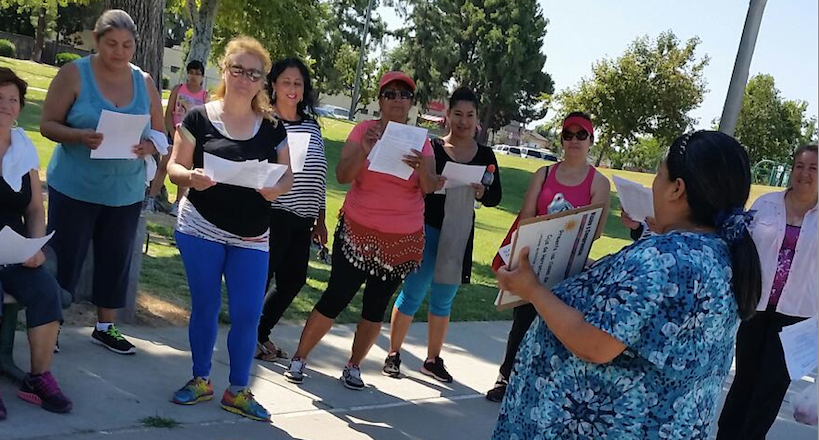
The Greenfield Walking Group has been another grantee, which received funding to purchase two speakers to use at the group’s daily Zumba class at Stiern Park in southeast Bakersfield. Regular Zumba classes are bringing outdoor physical activity opportunities to the residents of Greenfield and inspiring people to get off the couch and move.

Applications can be made by any group of residents, youth, or community partners such as parent groups, groups of neighbors, or others. Groups should be from the communities of Arvin, Lamont, Weedpatch, or the unincorporated areas of Greenfield. If you need assistance completing the application, contact Angelica Munoz at (661) 845-2724.

Applications can be found at www.healthysouthkern.org. Applications must be submitted by 5:00 p.m., August 11 to 7839 Burgundy Avenue in Lamont.

BHC-SK is a community initiative comprised of over 2,000 residents, youth, businesses and organizations who are working to improve community health and initiate systemic change by moving policies and practices in the areas of education, environment, recreation and health-access in the communities of Arvin, Lamont, Weedpatch, and the unincorporated areas of Southeast Bakersfield.

English Application

Spanish Application

KEEN

Building Healthy Communities-South Kern’s Program Manager Annalisa Robles was among the dozens of state and local leaders who gathered in Sacramento early this month to discuss a report on helping residents of underserved communities report environmental hazards more effectively.

The summit was held at the Sacramento offices of the California Environmental Protection Agency to discuss the report conducted by the University of California Davis Center for Regional Change on the Identifying Violations Affecting Neighborhoods (IVAN) program.

IVAN, which forms a partnership that helps residents report these hazards to enforcement agencies, should be enhanced and expanded, says the report.
The innovative program studied by UC Davis researchers helps residents identify environmental hazards through digital technology and crowd sourcing.

IVAN is the Kern Environmental Enforcement Network (KEEN) equivalent that was seeded and supported by The California Endowment through Building Healthy Communities, South Kern. The network was created after the community made it a top priority to hold federal, state and local regulators accountable for enforcing and monitoring protective policies from environmental hazards in affected communities.

BHC-SK’s partners, Gustavo Aguirre Jr. and Cesar Campos, also attended the event. Campos, who is responsible for bringing KEEN to Kern, also spoke at the summit.

KEEN’s mission is to build the capacity of community residents to identify and report hazards in their neighborhoods in an effort to keep them safe and healthy.

Click here to read the full report.

KW9_6C1O92ZQ9FUdsdhmhxglA06TexT5uJGGmyf2LV9oKuY8k75bt18h20_hx_5NUOLxwwNv7GnUXNCNgnVvF8U0idOt2XTmXRCIz5gaEZkWeYM8fDJuqhbSYfRMd-VqxfjV=s0-d-e1-ft

Rural Community Assistance Corporation and the Community Water Center kicked-off their Safe Water Program at the Sierra Vista Elementary School Cafeteria in Arvin in June.

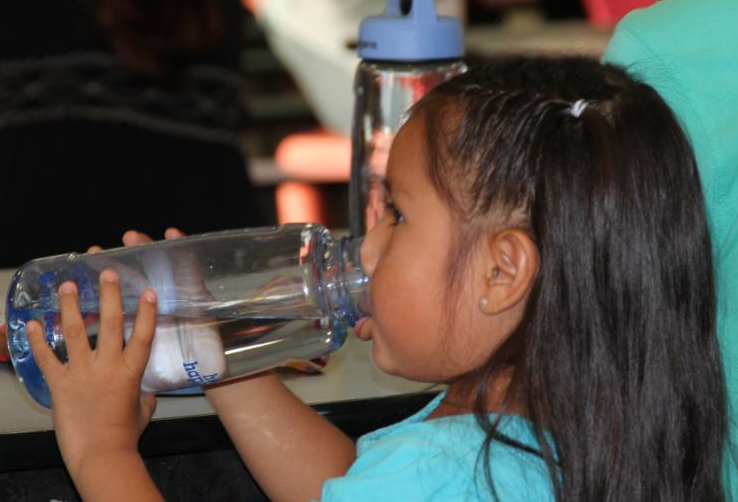
About 50 residents gathered to celebrate the first round of installations of point-of-use treatment systems on water fountains in Sierra Vista Elementary School. More than 70 water treatment systems, designed to remove arsenic from the water will be installed in the coming months in local schools, libraries, health clinics, and other community spaces in Arvin.

The program is part the #Agua4all initiative, a project of The California Endowment and other groups including the Rural Community Assistance Corporation and the Community Water Center, to provide residents with access to clean drinking water.

Click here to learn more about the #Agua4all initiative.


South Kern Sol, News Report, Staff

Photo above: Beatriz Basulto talks to residents

Beatriz Basulto and Marisela Sanchez joined Dignity Health in June as community health educators to work on helping residents get access to healthcare.

As trusted members of their community, Basulto and Sanchez serve as community advocates, educators, mentors, and outreach workers.

Basulto, 52, began attending the Greenfield Walking Group’s walking sessions to sell Jafra beauty products to the members after their walks. After a while, she realized that she was no longer attending the exercise session to sell Jafra, but to meet with her friends and sometimes listen to community organizations that presented information on available resources.

Basulto eventually came across the nonprofit organization Vision y Compromiso, which provides leadership and ongoing advocacy support for Promotoras and Community Health Workers.

Photo above: Marisela Sanchez

“Vision y Compromiso’s regional director came to talk to us about the ‘promoter’ concept,” said Basulto, a mother of one. “I was empowered by [Vision y Compromiso].”

The “promotoras,” have been trained by Dignity Health with Vision y Compromiso’s help from Stanford University on the prevention of diabetes, chronic disease, and suicide.

“[What I like most about my new role is being able to give information on resources available to my community and educate them to make healthy decisions,” said Basulto.

Sanchez, 40 and a mother of three, started teaching fitness classes for free in the garage of her Greenfield home 11 years ago.

“The community has always trusted me; they have always approached me to ask questions,” said Sanchez, who met Vision y Compromiso’s regional director during one of her fitness classes. “Meeting people and…working towards helping them [are what inspire me].”

To learn more or to get involved email, Nancy De la Torre at nancy.delatorre@dignityhealth.org.

310874_259888577397346_1695225367_n-596x356

The Rose Foundation Northern California Environmental Grassroots Fund is providing small grants ($5,000 or less) to community groups that are tackling tough environmental problems: water, toxic pollution, urban sprawl, climate change, environmental degradation. 

The grants are awarded every three months and the next application deadline is August 1.
Click here for additional information.

7

Do you have a project that would benefit the communities of Arvin, Lamont, Weedpatch, and the unincorporated areas of Greenfield, but need funds to purchase materials? If so we may be able to help. Apply for a grant today!

Grants to Build Healthy Communities

The Grants for Blocks Program will provide up to $500 in materials/supplies to groups of residents or youth from South Kern to complete projects that will improve our community.

What is Building Healthy Communities – South Kern?

Building Healthy Communities – South Kern is an effort to positively change the health of our communities through a shared vision, goals, and Action Plan. Residents, youth, businesses, and organizations in Arvin, Lamont, Weedpatch and the unincorporated areas of Greenfield are working together to make our communities healthier, and to create a brighter future for our children.

Who can apply for Grants to Build Healthy Communities?

Applications can be made by any group of residents, youth, or community partners such as parent groups, groups of neighbors, youth or student groups, or others. Groups should be from the communities of Arvin, Lamont, Weedpatch, or the unincorporated areas of Greenfield.

What can funds be used for?

Funds can be used for any project that would benefit the communities of Arvin, Lamont, Weedpatch, and the unincorporated areas of Greenfield. Funds can only be used for materials or supplies and not to pay for services or the time it takes to complete the projects. Projects must be completed by November 30, 2015.

What factors will be used to decide which projects are funded?

Projects will be scored based on showing that they are:

  • Addressing a significant need in the communities of South Kern;
  • Meeting this need by making real and lasting improvements in our communities;
  • Led by residents or youth from South Kern;
  • Bringing different people and groups together, especially new groups or residents;
  • Using the $500 available for reasonable and pre-defined project expenses;
  • Bring additional resources beyond the $500 grant amount, such as additional funds or volunteer time;
  • Helping make our communities healthier places to live, work, and play;
  • Innovative or unique;
  • Supporting BHC-SK priorities (Education, Environment, Health, Recreation, and Economic Development).
  • How do I apply for funding?
  • Fill out and submit the application attached. If you need assistance completing the application, contact Angelica Munoz at 661-845-2724 for assistance.
  • Workshops will also be held in mid to late July to assist you in completing the application. To find out when a workshop near you will be held, visit our website, www.healthysouthkern.org, or call 845-2724.
  • Submit the application by 5:00pm on Friday, August 11th to 7839 Burgundy Avenue in Lamont. No late applications will be accepted.
  • We expect to fund $6500 in projects this year.
  • Funded applications will be limited to one per Group/Resident
  • Groups/Residents will be notified by August 31st if their application will be considered for funding.
  • Finalists will be asked to present to the BHC-SK Steering Committee on September 10th.
  • Funds must be spent by November 30th 2015
  • Workshops will also be held to assist you in completing the application.
      • July 21st 2015 5:30-6:30 @ FRC in Lamont 7839 Burgundy Ave Lamont CA 93241
      • July 24th 2015 5:30-6:30 @ Rexland Center 325 E. Fairview Ave Greenfield CA
      • July 27th 2015 5:30-6:30 @ Valley of Faith Church 500 Campus Ave, Arvin CA

For more details about the grant or application process, or for any other questions, visit our website, www.healthysouthkern.org or contact Marina Ugues, BHC-SK Program Assistant at the Lamont/Weedpatch Family Resource Center, 661-845-2724, 7839 Burgundy Avenue, Lamont.

Grants for blocks application application 2015

Spanish Grants for blocks application application 2015-SP


Please join us at a public gathering to kick-off the Safe Water Program in Arvin at the Sierra Vista Elementary School Cafeteria on Monday, June 15, from 6-8pm.

We hope you’ll join us at this community event to celebrate the first round of installations of point-of-use treatment systems on water fountains in Sierra Vista Elementary School. These treatment systems, specifically designed to remove arsenic from the water, will be on display. We will have a walking tour to see the systems installed on the fountains and hear from the local community leaders who have supported this project from the beginning. Your strong support and partnership for safe water in your community will result in the local schools, libraries, health clinics, and other community spaces in Arvin getting a total of more than 70 of these treatment systems. Come and try safe water treated by the new point-of-use systems, and be sure to bring your new, reusable Agua4All water bottle! Meet and celebrate the school, community partners, and non-profits that made this happen.

The meeting is hosted by the Rural Community Assistance Corporation and the Community Water Center. This project is funded by the California State Water Resource Control Board, The California Endowment, and Helping Hands for Water.

**Please note that this event will be filmed for an upcoming documentary and we will be asking for waivers to have permission to film participants at the event. If you do not wish to be filmed, let us know and you can be seated in a special section but we would still love for you to attend!

DATE

Monday, June 15

TIME

6-8pm

LOCATION

Sierra Vista Elementary School Cafeteria, 300 Franklin St. Arvin, CA

THANK YOU FOR YOUR CONTINUED SUPPORT!  

QUESTIONS?

If you have any questions about the event or this project, please contact Gerardo Tinoco, Jr. at gerardo.tinoco@communitywatercenter.org or call (661) 345-9976.